
Protecting the Environment
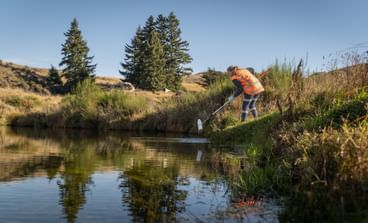
Water Management
Water quality is one of the most closely monitored parts of the Macraes Operation.
We carry out comprehensive monitoring across the catchment, overseen by the Otago Regional Council.
Water affected by mining activities is captured, managed and treated before it’s released. Clean water is diverted around operational areas wherever practical.
We continue to invest in water treatment technology, including ongoing pilot testing to improve outcomes over time.
We are proposing that our commitment to improved water quality and ecological outcomes in the rivers and streams downstream of the mine is included in new conditions for the site as part of the MP4 process.
Tailings Storage Facilities
Are our tailings storage facilities safe? Yes.
The way we design and operate tailings storage today is aligned to the Global Industry Standard on Tailings Management, the highest international standard in use today. Our tailings storage facilities are independently monitored, subject to regulatory oversight, and have operated safely for many years.
A Dam Safety Management Plan governs ongoing monitoring and surveillance for each tailings storage facility, assessed by the facility’s design engineer. Annual safety and integrity reports are reviewed by an independent peer review panel.
The Frasers Tailings Storage Facility has been designed to resist catastrophic failure in the event of a one in 10,000 year earthquake.
Seepage from our tailings storage facilities is subject to the same high standards for water quality leaving the site as those applying to the wider operation.
Ecology and Biodiversity
We apply the effects management hierarchy to everything we do: avoid effects first, minimise what can’t be avoided, and mitigate through compensation what remains.
The Macraes Ecological Enhancement Area (MEEA) is one of our most significant biodiversity initiatives. It includes a large predator-exclusion fenced area and wider pest management zones, designed to protect and enhance indigenous species.
We run ongoing programmes for lizard salvage and translocation, wetland restoration, and stream compensation, with long-term monitoring to track outcomes through construction, operation and closure.
Air Quality, Noise and Vibration
We manage dust through a combination of measures such as water carts, dust suppression on tailings facilities, and speed restrictions on haul roads.
Noise is managed through acoustic cladding, careful equipment selection, and a Noise Management Plan with strict limits.
For blasting, we provide an audible warning system, and daily notifications for nearby residents who request them.
Closure and Rehabilitation
All our New Zealand operations have closure plans, reviewed annually.
Rehabilitation isn’t something we leave until the end. It happens progressively, throughout the life of the project. Frasers East and South are good examples: substantial rehabilitation is already complete in both areas.
A bond ensures rehabilitation is completed even if the company is no longer operating, and that bond is reviewed annually. MP4 is proposing to include a permanent trust, funded to manage the site after closure.
We’re committed to leaving the land in a better condition than we found it.